Fair Trial-Circumstantial Evidence Must Be Unbroken and Credible — The Supreme Court Sets Aside Death Sentence in POCSO Case.
February 3, 2017
“Embedded Value, Embedded Tax: Supreme Court’s Verdict Bridges Trade Tax and GST. The Continuing Legacy of Section 3F(1)(b) in the GST Era.
October 24, 2025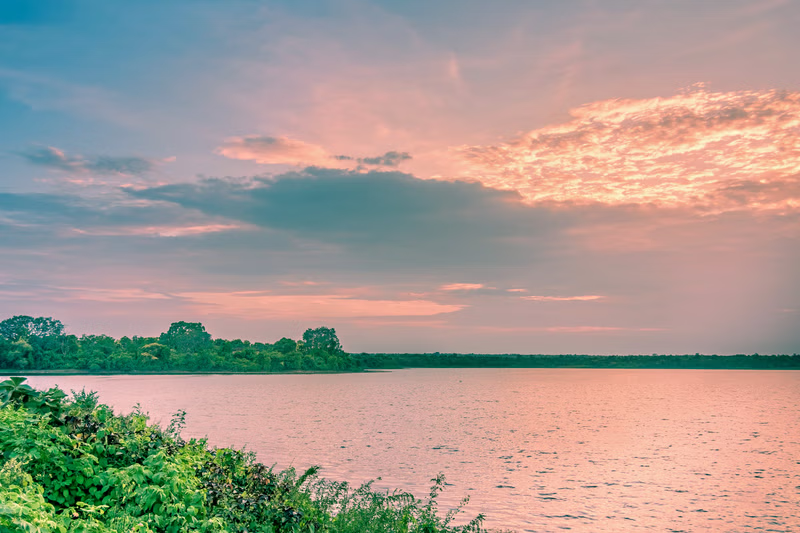
Swacch Association, Nagpur v. State of Maharashtra & Ors. (2025 INSC 1199) Decided on 07 October 2025 By: CJI B.R. Gavai, J. K. Vinod Chandran & J. N.V. Anjaria
Headnote
The Supreme Court held that Futala Lake in Nagpur, though an important Ecological Landmark, is not a “Wetland” under Rule 2(1)(g) of the Wetlands (Conservation and Management) Rules, 2017, since it is Man-Made Lake for Irrigation and Recreation purposes, made in 1799 by the Bhonsales, Futala Lake is not a wetland under the 2017 Rules
However, the Court reaffirmed that the Doctrine of Public Trust continues to govern such Waterbodies-mandating that no permanent construction be permitted and that the lake’s ecological integrity must be preserved.
Brief Facts
An NGO, Swacch Association, Nagpur, challenged before the Bombay High Court the construction of a musical fountain, viewers’ gallery, floating restaurant, artificial banyan tree and parking plaza at Futala Lake in Nagpur, alleging violation of the Wetlands Rules, 2017 and environmental laws.
The High Court rejected the plea, holding that Futala Lake was Not a Wetland. The Appeal before the Supreme Court questioned that conclusion and sought restoration of the lake to its natural state.
Rules & Laws Involved
- Wetlands (Conservation and Management) Rules, 2017–Rule 2(1)(g): Definition of “Wetland.” And Rule 4(2)(vi): Prohibits permanent construction within 50m of a wetland.
- Environment (Protection) Act, 1986
- Constitution of India–Article 21: Right to a clean and healthy environment and Articles 48-A & 51-A(g): State and citizen duties to protect environment.
- Doctrine of Public Trust–M.C. Mehta v. Kamal Nath, (1997) 1 SCC 388
Key Observations & Principles Settled
- Definition of Wetland:
Man-made tanks or lakes constructed for irrigation, drinking, or recreation are excluded from the statutory definition of “Wetland.” - Public Trust Doctrine Extended:
Even artificial or man-made waterbodies are Public Ecological Assets, protected under the Public Trust Principle-preventing private or commercial exploitation. - Sustainable Balance:
The Court emphasized that urban beautification and environmental preservation must coexist — allowing public recreation without ecological harm.
Verdict
- The Court upheld the Bombay High Court’s view that Futala Lake is not a wetland.
- Nonetheless, No Permanent Construction may be carried out within the lake.
- Authorities must maintain cleanliness, prevent pollution, and ensure environmental harmony in all development activities.
Environmental Impact Analysis
- This judgment strikes a delicate balance between urban development and environmental stewardship.
By excluding man-made lakes from the statutory definition but invoking the spirit of the Wetlands Rules, the Court ensured that artificial ecosystems also receive constitutional protection. - The decision reinforces green accountability — obligating civic bodies to preserve heritage lakes as public environmental commons rather than commercial assets.
Cases Relied Upon
M.K. Balakrishnan v. Union of India, W.P. (C) No. 230/2001 (Orders dated 08.02.2017 & 04.10.2017 -Wetlands Identification and Protection) and M.C. Mehta v. Kamal Nath & Ors., (1997) 1 SCC 388 — (Public Trust Doctrine)
Author
Abhijit Banerjee
Advocate-on-Record & Arguing Counsel
Supreme Court of India
(Legal Analysis | Environmental Jurisprudence | October 2025)
#EnvironmentalLaw #WetlandsJudgment #PublicTrustDoctrine #SustainableDevelopment #EnvironmentalJustice #UrbanEcology #SupremeCourtJudgment #EnvironmentalGovernance #ConstitutionalLaw #GreenJurisprudence